
If your New Year's resolution
is to lose those last few pounds that are keeping you out of your
skinny jeans, a new review suggests you may want to think twice.
The research reinforces a counterintuitive point that past studies have
suggested -- being a bit on the heavy side may actually cut your risk of
dying prematurely.
In the review, published in this week's Journal of the American Medical
Association, researchers looked at nearly 100 studies involving 2.88
million people that compared body mass index, or BMI, to the risk of
death from any cause.
BMI is derived from a formula that compares your height to your weight.
It is currently the standard means of determining whether someone is
underweight, of normal weight, overweight or obese.
Not surprisingly, the researchers found that the heaviest among us --
those who have a BMI above 30 -- have a higher risk of death than those
who are considered to be at a "normal" weight, or a BMI between 18.5 and
25.
But the researchers also found a slight dip in death risk -- about 6
percent -- in those whose BMIs were between 25 and 30. In other words,
people who would be classified as overweight appear to have a lower risk
of death from any cause.
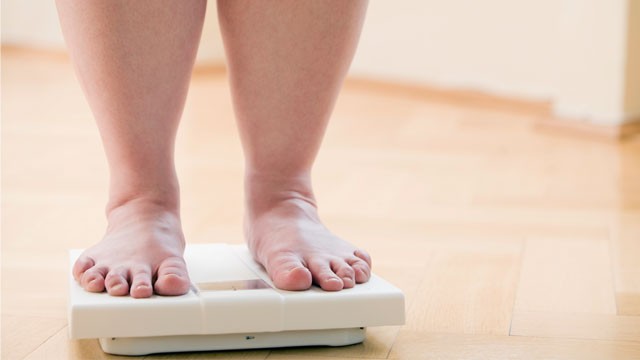
Being overweight may not be a bad thing when it comes to lowering your risk of death, a new review suggests.
Moreover, for those who were considered to be on the lower end of the
obesity spectrum, with a BMI of 30 to 35, the risk of death from any
cause was not significantly different from that experienced by those who
were at a normal weight.
As is apparent from the number of studies examined in this review, this
is not the first time that a link has been suggested between being a tad
on the heavy side and having a decreased risk of death. And several past studies
have disputed this link. But this new review may lend support to the
idea that our health may not be as closely tied to the numbers on our
scales as we might have been led to believe.
Lead study researcher Katherine Flegal, Ph.D., of the CDC's National
Center for Health Statistics, said the review was in many ways a
follow-up to research she and her colleagues published in 2005 that suggested a slightly higher-than-normal BMI was necessarily attached to life-threatening conditions such as heart disease.
"We found that being overweight in that study was not associated with
excess mortality from cardiovascular disease or cancer, but it reduced
mortality from other things," Flegal said. "There's even some research
that suggests body fat itself could be cardioprotective."
On one hand, said obesity experts not involved with the research, the
findings suggest that the current widespread use of BMI as a way to
determine if one is overweight or obese may need to be reconsidered.
Flegal said that the problem may not be the BMI scale, but, rather, how
the different rungs on the BMI ladder are interpreted by doctors. In
this way, such research may have implications for physicians who
currently advise patients in the overweight BMI category to lose a few
pounds.
"These are not health categories, these are weight categories," Flegal said.
Dr. David Katz, director of Yale University's Prevention Research
Center, agreed that this review supports the idea that doctors may need
to reexamine the way they advise certain patients.
Page One
"In a society prone to both epidemic and increasingly severe obesity, it
may be that those who manage to remain in the 'overweight' class are,
in fact, those who are actually doing quite well," said Katz, who was
not involved with the study. "This study suggests that if the basis for
defining 'overweight' is adverse health effects, we may want to raise
the threshold. The definition of 'overweight' should begin where health
risks begin."
Katz pointed out that the study looked only at death rates -- not
quality of life. And this is an area, he said, that may be affected by
being overweight or slightly obese.
"We have recent evidence -- from the Lancet's 'Global Burden of Disease'
study -- that we are living longer, but sicker," he said. "It may be
that overweight does, indeed, contribute to type 2 diabetes and heart
disease, but not to premature death.
"Living is not really the prize; living well is the prize. So we should
be careful before jumping to conclusions about these findings."
Dr. Mitchell Roslin, chief of obesity surgery at Lenox Hill Hospital in
New York, said it is important to recognize that many people who are
overweight may in fact be moving toward obesity and its myriad health
effects.
"Your weight is a moving target, and usually in the wrong direction,"
Roslin, who was also not involved with the study, said. "Unfortunately,
many people gain several pounds each year and this becomes a pathway to
morbid obesity, which, as the study shows, is very detrimental."
Katz agreed. "'Overweight' does not tend to be a permanent state; it is
often a transitional state, leading to obesity," he said. "If you are
lean and gain weight, you will become overweight. If you continue to
gain weight, you will become obese. If you are slightly overweight, and
remain that way, it means you are actually controlling your weight
better than most -- and perhaps that's why health risks may not ensue.
"This study is an argument for, not against, weight control -- it just
may be an argument for controlling weight in a slightly wider range than
we thought."
So this New Year's, as you find yourself standing on the scale, what
should your resolution be? Flegal, for one, said that this study should
not be a guide to individual action. But Roslin said the study may
provide some perspective for those worried about how their weight might
be affecting their health.
"The most important message is to eat right and be fit," he said.
"Nominal weight loss and stabilization are worthwhile goals. Skinny is
not always better."
Page Two
Page Two

No comments:
Post a Comment